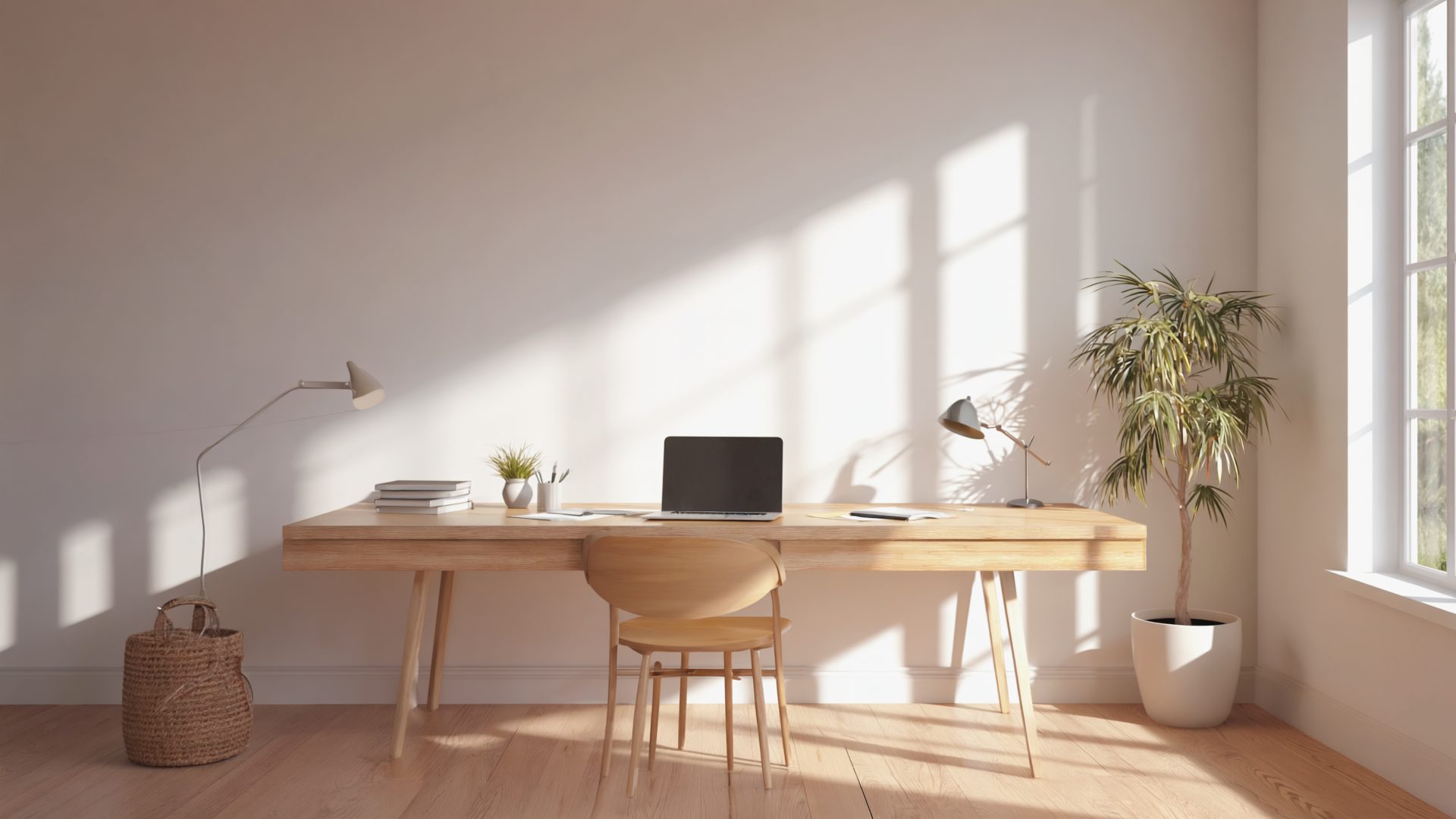
You spend 8+ hours a day in your home office. The air quality in that room directly affects your cognitive performance, energy levels, and long-term health. Studies have linked poor indoor air quality to reduced productivity, increased fatigue, and difficulty concentrating.
Here is a practical guide to improving your home office air quality with plants and purifiers — including an honest assessment of what actually works.
Why Home Office Air Quality Matters
Indoor air can be 2-5 times more polluted than outdoor air, according to the EPA. Common home office pollutants include:
- VOCs (Volatile Organic Compounds): Off-gassed from furniture, paint, carpet, and cleaning products
- CO2: Your own breathing in a closed room raises CO2 levels, which impairs cognitive function
- Particulate matter: Dust, pet dander, pollen
- Mold spores: Common in humid environments
- Formaldehyde: Released by pressed-wood furniture and some building materials
The most immediate issue for home office workers is elevated CO2. A single person in a closed room can raise CO2 from ambient levels (around 400 ppm) to 1000+ ppm within an hour. Research suggests that cognitive function measurably declines above 1000 ppm.
The Simple Fix: Ventilation
Before spending money on plants or purifiers, address ventilation:
- Open a window: Even cracking a window provides enough fresh air exchange to keep CO2 manageable
- Use a fan: A small desk fan near an open window improves air circulation
- Do not keep your door closed all day: If you cannot open a window, leave the office door open periodically
- Run HVAC: Central heating and cooling systems circulate and filter air. Run the fan even when heating/cooling is not needed.
Ventilation alone solves the CO2 problem. No plant or purifier can fix that as effectively as simply exchanging air with the outdoors.
Plants: What They Can and Cannot Do
The Honest Truth About Plants and Air Quality
NASA's famous 1989 study found that certain plants could remove VOCs from sealed chambers. This finding was widely popularized, but subsequent research has tempered the claims significantly.
What the research actually shows:
- Plants do remove some VOCs, but at rates too slow to meaningfully clean a room
- You would need an unrealistic number of plants (hundreds per room) to match a mechanical air purifier
- The soil microbiome may contribute more to VOC removal than the plant leaves
What plants actually do for your office:
- Psychological benefits: Multiple studies show that visible greenery reduces stress and improves mood
- Humidity: Plants release moisture through transpiration, slightly increasing humidity
- Aesthetics: A pleasant environment you enjoy spending time in is genuinely valuable
- Noise absorption: Dense foliage can slightly reduce ambient noise
Best Plants for a Home Office
Choose plants based on your conditions — not NASA air quality claims:
Low Light (North-Facing Windows, Interior Rooms)
If your office gets little natural light, our guide to the best low-light plants for home offices covers the most forgiving options in detail.
Pothos (Epipremnum aureum)
- Nearly indestructible
- Thrives in low light
- Trailing vines add visual interest on shelves
- Water when soil is dry
Snake Plant (Sansevieria)
- Tolerates neglect extremely well
- Upright form does not take up desk space
- Releases oxygen at night (most plants do this during the day)
- Water every 2-3 weeks
ZZ Plant (Zamioculcas zamiifolia)
- Handles low light and irregular watering
- Glossy leaves look healthy even with minimal care
- Slow grower — will not outgrow its space quickly
Medium Light (East or West-Facing Windows)
Spider Plant (Chlorophytum comosum)
- Produces baby plants that hang from runners
- Hard to kill
- Prefers indirect light
- Good for hanging planters or shelf edges
Peace Lily (Spathiphyllum)
- Produces white flowers in adequate light
- Droops visibly when thirsty (a helpful reminder)
- Slightly larger — good as a floor plant beside your desk
Rubber Plant (Ficus elastica)
- Bold, dark leaves
- Grows into a substantial plant over time
- Prefers medium light but tolerates lower conditions
Bright Light (South-Facing Windows)
Fiddle Leaf Fig (Ficus lyrata)
- Statement plant with large, sculptural leaves
- Requires consistent watering and light
- More demanding than other options but visually striking
Aloe Vera
- Succulent — minimal watering
- Bright light requirement
- Compact size works on desks and windowsills
Keeping Plants Alive with Minimal Effort
- Set a watering schedule: Check all plants every Sunday. Water only those with dry soil.
- Use self-watering pots: These have a reservoir that plants draw from as needed. Reduces watering to once every 2-3 weeks.
- Start with forgiving plants: Pothos and snake plants survive almost anything. Build confidence before attempting a fiddle leaf fig.
- Use grow lights if needed: A small grow light ($18-30) keeps plants healthy in rooms with poor natural light.
Air Purifiers: What Actually Works
HEPA Filters
HEPA (High-Efficiency Particulate Air) filters are the gold standard for air purification. They capture 99.97% of particles 0.3 microns and larger — including dust, pollen, pet dander, and mold spores. For a deeper comparison of models, see our roundup of the best air purifiers for home offices.
What HEPA does well: Removes particulate matter from the air. If you have allergies, a HEPA purifier makes a noticeable difference.
What HEPA does not do: Remove gases, VOCs, or odors. For those, you need an activated carbon filter (many purifiers include both).
Recommended Air Purifiers for a Home Office
Levoit Core 300 (Around $85-110)
A compact HEPA purifier suited for rooms up to 200 sq ft — perfect for a typical home office.
- Three-stage filtration (pre-filter, HEPA, activated carbon)
- Quiet on low settings (24 dB, according to the manufacturer)
- Small footprint
- Filter replacement every 6-8 months (around $22-28 per filter)
Coway Airmega AP-1512HH (Around $160-190)
A step up in coverage (up to 360 sq ft) and features.
- Four-stage filtration
- Air quality indicator LED
- Eco mode that shuts off when air is clean
- ENERGY STAR certified
- Very popular choice for home offices and bedrooms
Blueair Blue Pure 411 (Around $110-130)
Simple, quiet, and effective for small rooms.
- One-button operation
- Combination HEPA and carbon filter
- Washable pre-filter (fabric exterior in multiple colors)
- Low energy consumption
What to Skip
- Ionizers and ozone generators: Some air purifiers use ionization, which can produce ozone — a lung irritant. Stick with mechanical HEPA filtration.
- UV-C purifiers: UV-C can kill some pathogens, but the exposure time in a portable purifier is usually too short to be effective. Marketing exceeds function.
- Expensive smart features: Air quality sensors and app connectivity are nice but add cost. The filtration is what matters.
2026 Purifier Updates
The home air purifier market has seen notable updates in 2026:
- Levoit Core 300S: Smart version of the popular Core 300, now with app-controlled scheduling, real-time air quality readings via a built-in PM2.5 sensor, and Alexa/Google Home integration. Costs about $10-15 more than the standard model. Worth it if you want automated schedules.
- Coway Airmega 150: Compact alternative to the AP-1512HH for rooms up to 214 sq ft. Smaller footprint, lower price point ($100-130), and the same quality HEPA filtration Coway is known for. A strong contender for smaller home offices.
- Dyson Purifier Big Quiet+: Dyson's 2026 flagship. Ultra-quiet operation (claims library-quiet at lowest setting) with HEPA H13 and activated carbon. Expensive ($550+) but covers large rooms and doubles as a fan. Overkill for most home offices but worth noting.
CO2 Monitors Worth Considering in 2026
CO2 monitoring has become more affordable:
- Aranet4 HOME ($160-180): Still the gold standard. E-ink display, Bluetooth to phone app, and excellent accuracy. Battery lasts 2+ years.
- Qingping Air Monitor Lite ($50-70): Budget alternative with CO2, temperature, and humidity. Smaller display but accurate readings and Apple HomeKit support.
Air Purifier Comparison
| Purifier | Coverage | Price | Filter Cost/Year | Best For |
|---|---|---|---|---|
| Levoit Core 300 | Up to 200 sq ft | $85–110 | ~$40–50 | Best value for small offices |
| Levoit Core 300S | Up to 200 sq ft | $95–125 | ~$40–50 | Smart scheduling and monitoring |
| Coway Airmega 150 | Up to 214 sq ft | $100–130 | ~$35–45 | Compact form factor |
| Coway AP-1512HH | Up to 360 sq ft | $160–190 | ~$45–55 | Larger rooms, eco mode |
| Blueair Blue Pure 411 | Up to 190 sq ft | $110–130 | ~$30–40 | Simplicity, quiet operation |
A Practical Air Quality Setup
For a typical home office (100-200 sq ft):
- Ventilation: Open a window or door for 10-15 minutes at least twice during your workday
- HEPA purifier: Run a Levoit Core 300 or similar on low speed continuously
- 2-3 plants: A snake plant on the floor, pothos on a shelf, and a small plant on your desk. For psychological benefit and aesthetics, not air purification.
- Humidity: If your office is dry (below 30% relative humidity), a small humidifier prevents dry eyes, skin, and respiratory irritation. Target 40-50% humidity.
Total cost: $85-130 for the purifier + $25-45 for plants and pots = $110-175.
Monitoring Air Quality
If you want to know what you are actually dealing with, an air quality monitor provides data:
- Aranet4 (around $160-180): Monitors CO2, temperature, and humidity. Shows you exactly when your room needs ventilation.
- Temtop M10 (around $75-85): Monitors PM2.5, formaldehyde, and VOCs.
These are optional but useful. The CO2 monitor in particular gives you actionable data — when it crosses 1000 ppm, open a window.
Frequently Asked Questions
Do indoor plants actually clean the air?
Plants remove some VOCs, but at rates too slow to meaningfully clean a room. NASA's 1989 study showed results in sealed chambers, but real-world rooms are much larger and have continuous pollutant sources. You would need hundreds of plants per room to match a HEPA purifier. Plants do provide real psychological benefits — reduced stress, improved mood, and subtle humidity increases — but should not be relied on for air purification.
What is the best air purifier for a home office?
The Levoit Core 300 ($85-110) is the best value for rooms up to 200 sq ft. It has three-stage HEPA filtration (pre-filter, HEPA, activated carbon) and runs quietly at 24 dB on low. For smart features, the Core 300S adds app control and a PM2.5 sensor for about $10-15 more. For larger rooms up to 360 sq ft, the Coway Airmega AP-1512HH ($160-190) adds an air quality indicator and eco mode.
How do I lower CO2 levels in my home office?
Open a window or door for 10-15 minutes at least twice during your workday. A single person in a closed room can push CO2 above 1000 ppm within an hour, which measurably impairs cognitive function. No plant or air purifier can reduce CO2 as effectively as simply exchanging air with the outdoors. A CO2 monitor like the Aranet4 ($160-180) tells you exactly when ventilation is needed — open a window when it crosses 1000 ppm.
What humidity level is best for a home office?
Target 40-50% relative humidity. Below 30%, you risk dry eyes, skin irritation, and respiratory discomfort. Above 60%, mold growth becomes a concern. If your office is consistently dry, a small desk humidifier ($20-40) helps. Most air quality monitors (including the Aranet4 and Qingping Air Monitor Lite) also track humidity.
How often should I replace my air purifier filter?
Most HEPA filters need replacement every 6-12 months depending on usage and air quality. Running a purifier continuously in a dusty or pet-friendly home shortens filter life to around 6 months. Replacement filters typically cost $22-55 depending on the model. Some purifiers have a filter indicator light that alerts you when replacement is needed.
The Bottom Line
The highest-impact improvements in order:
- Ventilate (free): Open a window. This alone handles CO2 and brings in fresh air.
- HEPA purifier ($85-130): Runs continuously and removes particulates.
- Plants ($25-45): For mood, aesthetics, and subtle humidity benefits.
Do not buy plants expecting them to clean your air like a purifier. Do not buy a purifier expecting it to solve a CO2 problem that ventilation handles for free. Use each tool for what it actually does well, and your home office air will be better than most commercial office buildings.
Recommended Reading & Gear
- How to Grow Fresh Air by B.C. Wolverton — The NASA scientist's guide to choosing and caring for air-purifying indoor plants.
- Breath by James Nestor — How breathing and air quality affect focus, energy, and long-term health in enclosed spaces.
- Levoit Core 300 Air Purifier — Best value HEPA purifier for home offices up to 200 sq ft. Quiet, compact, three-stage filtration.
Explore More Reviews
- Best Mattresses for Back Pain Relief on RestWell
- Best Homeschool Curriculum Kits 2026 on KidGearPro